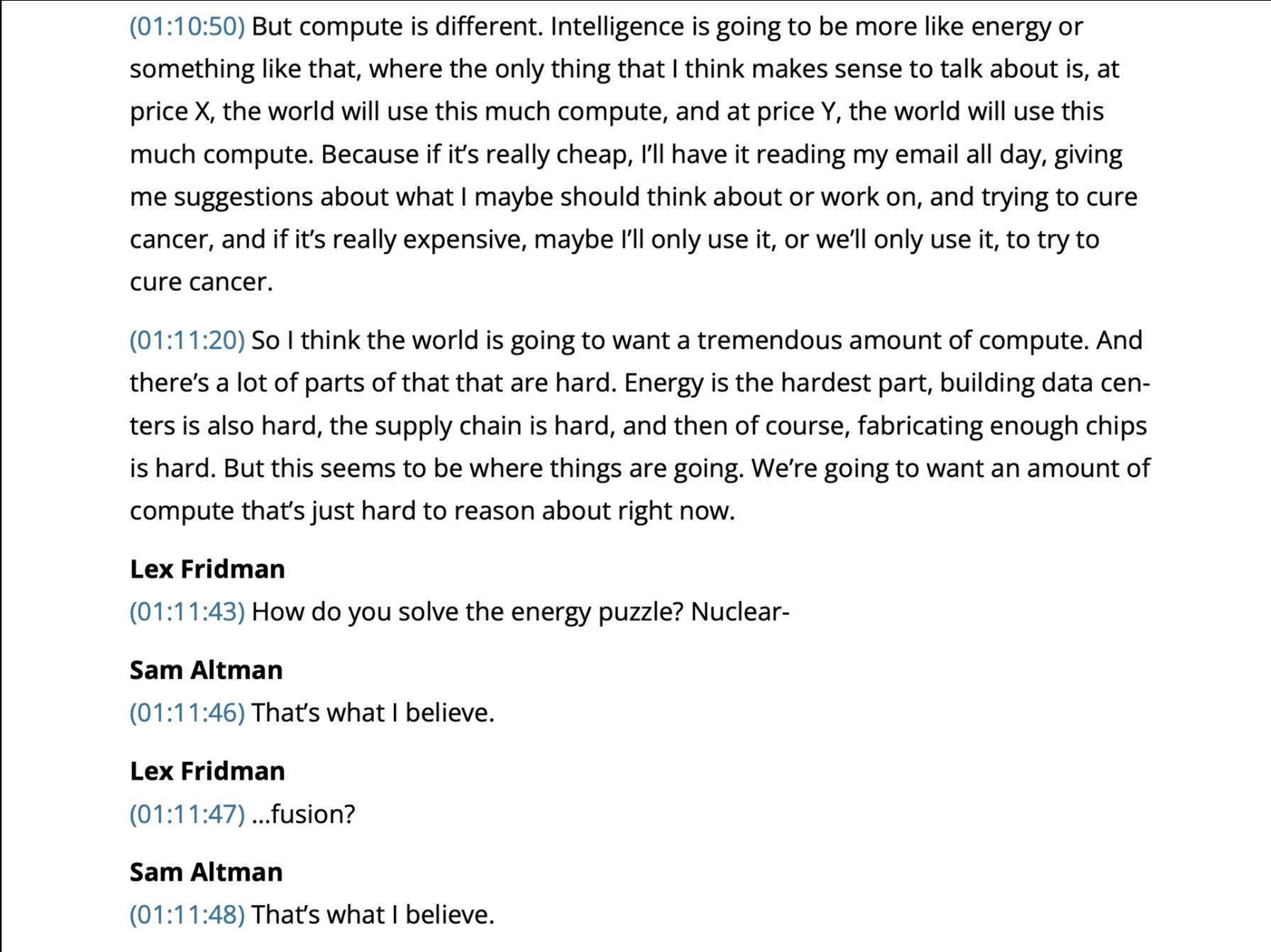
- ...the cost of energy... ……能源成本……
- and this is why Sam Altman himself has invested a lot of money in nuclear fusion which he believes is going to be or is most likely to be the direction in which this kind of energy problem is going to be solved. 这就是为什么山姆·奥特曼本人已经在核融合上投入了大量资金,他认为这将是或最有可能解决这类能源问题的方向。
- and no doubt he's a guy who has in mind to some extent the problems of climate change and fossil fuel use 而且毫无疑问,他在一定程度上考虑到了气候变化和化石燃料使用的问题
- and believes that not only that AI is going to be a benefit to the world, 并且相信人工智能不仅将造福世界,
- even though it's something he worries about, 尽管这是他担心的事情,
- but also that it can only be a benefit if some kind of solution to the production of energy is brought about 但前提是必须找到某种解决能源生产问题的方法,它才能带来益处。
- and my understanding, I don't know if nuclear fusion is realistic or unrealistic. Obviously this is a very technical question but it's also a question that I believe that AI has something to do with. 在我看来,我不知道核融合是否现实或不现实。显然这是一个非常技术性的问题,但我相信人工智能与此有关。
- There's a kind of a circle here in the sense that controlling the reactions is one of the main problems involved in making a scalable form of nuclear fusion and that AI somehow can solve this potentially in a way that more let's say mechanical methods find almost impossible because of the complexity of the process. 这里有一种循环,即控制反应是实现可扩展核融合形式的主要问题之一,而人工智能某种程度上可以以更机械的方法几乎不可能做到的方式解决这个问题。
- The second thing is when he's asked about the possibility of what he called general artificial intelligence [Ed.: AGI], in other words we could say real AI, in the sense that these kind of people talk. 第二件事是当他被问及他所说的通用人工智能[Ed.: AGI]的可能性时,换句话说,我们可以说这是真正的人工智能,因为这些人就是这样谈论的。
- First he wants to say that ChatGPT is really a non-event in this regard in the sense he asks, he the interviewee asks in this case, "do you feel that the global economy is any different?", and the answer is no for him, and for the interviewer, that it might have made a big splash but in terms of really making any kind of transformation we're very far from that yet 首先,他想说的是,在这一点上,ChatGPT 真的是一个无关紧要的事情。他问,在这种情况下,被采访者问道:“你觉得全球经济有任何不同吗?”,而他的回答是否定的,对于采访者来说,它可能引起了巨大的轰动,但就真正产生任何形式的变革而言,我们还差得很远。
- And when he's asked what would count as that kind of transformation the answer he comes up with is if it makes a significant difference to the rate of scientific discovery. 当被问及什么样的变革才算得上是这种变革时,他给出的答案是,如果它对科学发现的速率产生了显著影响。
- And you can you could ask here if this is related to the kind of thing that Chris Anderson was talking about with the end of theory, the idea that the correlations of patterns are able to be discovered so efficiently and so well with this massive use of data and these powerful and very rapid programs that it's no longer necessary to have hypotheses and so on and so forth, that simply discovery will be a matter of what is illuminated through these patterns and correlations and of course we know not only Stiegler but for instance Giuseppe Longo would say that one of the main problems with that idea is that you can always find patterns and correlations, if you have enough data, if you have a gigantic enough amount of data just for the sake of random effects, it will always be possible to find to be to find correlations and patterns that then may well be indicative of nothing. 你可以在这里询问,如果这与克里斯·安德森所说的理论终结有关,即通过大规模使用数据和这些强大而快速的程序,模式的相关性能够如此高效且出色地被发现,以至于不再需要假设等等,发现将只是通过这些模式和相关性所揭示的内容,当然,我们知道不仅斯蒂格勒,例如朱塞佩·隆戈会说,这个观点的主要问题之一是,如果你有足够的数据,如果你有足够庞大的数据量,仅仅为了随机效应,总是可能找到相关性和模式,这些相关性和模式可能完全没有指示意义。
- So one could look at it like that but at the same time I don't know if he's, Sam Altman is, quite as simple-minded as that. 所以从这个角度来看是可以的,但同时我不知道他,萨姆·奥特曼,是否像那样简单。
- I think what he's imagining is something some kind of tools that are used by researchers in some more noetic way let's say, and in case of technology rather than pure science where of course, the whole point here is that we don't want to make this distinction between pure science and technology anymore, you could point for example to the question of automated driving and say, well, in the case of Tesla what they did is tried to program how to drive a car through the city by itself etc. 我认为他所想象的是某种工具,这些工具被研究者以某种更“知性”的方式使用,比如说,在技术而非纯科学的情况下,当然,这里的关键是我们不再想在纯科学和技术之间做出区分。例如,你可以提到自动驾驶的问题,并说,在特斯拉的情况下,他们所做的是尝试通过编程让汽车在城市中自行驾驶等等。
- And then after a while they realized that it was very difficult especially because they didn't, they chose not to, use complicated radar systems (that other companies used), to rely on video, but that what they did have was gigantic amounts of data that were coming from the cars, and that this would be open to kind of AI analysis that could, through machine learning, solve this question of automated driving more efficiently and better than these more expensive and extremely hard to program solutions that have been tried before, and tried by other companies. 然后过了一段时间,他们意识到这非常困难,尤其是因为他们没有选择使用复杂的雷达系统(其他公司使用的),而是依赖视频,但他们拥有的是来自汽车的海量数据,这些数据可以接受某种人工智能分析,通过机器学习,可以更高效、更好地解决自动驾驶的问题,这比之前尝试过的更昂贵且极难编程的解决方案要好,而这些解决方案是由其他公司尝试的。
- Whether that in fact is achieved in the end is not yet decided I don't think, but probably it is on the way. 我认为最终是否能实现这一点尚未决定,但可能正在路上。
- And so you could make the case that in terms of technology this was, this is an example where this kind of computational program can accelerate greatly the rate of technological innovation in this kind of automation. 因此,你可以说在技术方面,这是一个例子,说明这种计算程序可以大大加速这种自动化领域的技术创新速度。
- The third thing is when he's asked about the consequences of reaching some kind of high level of AI. 第三点是当他被问及达到某种高水平人工智能的后果时。
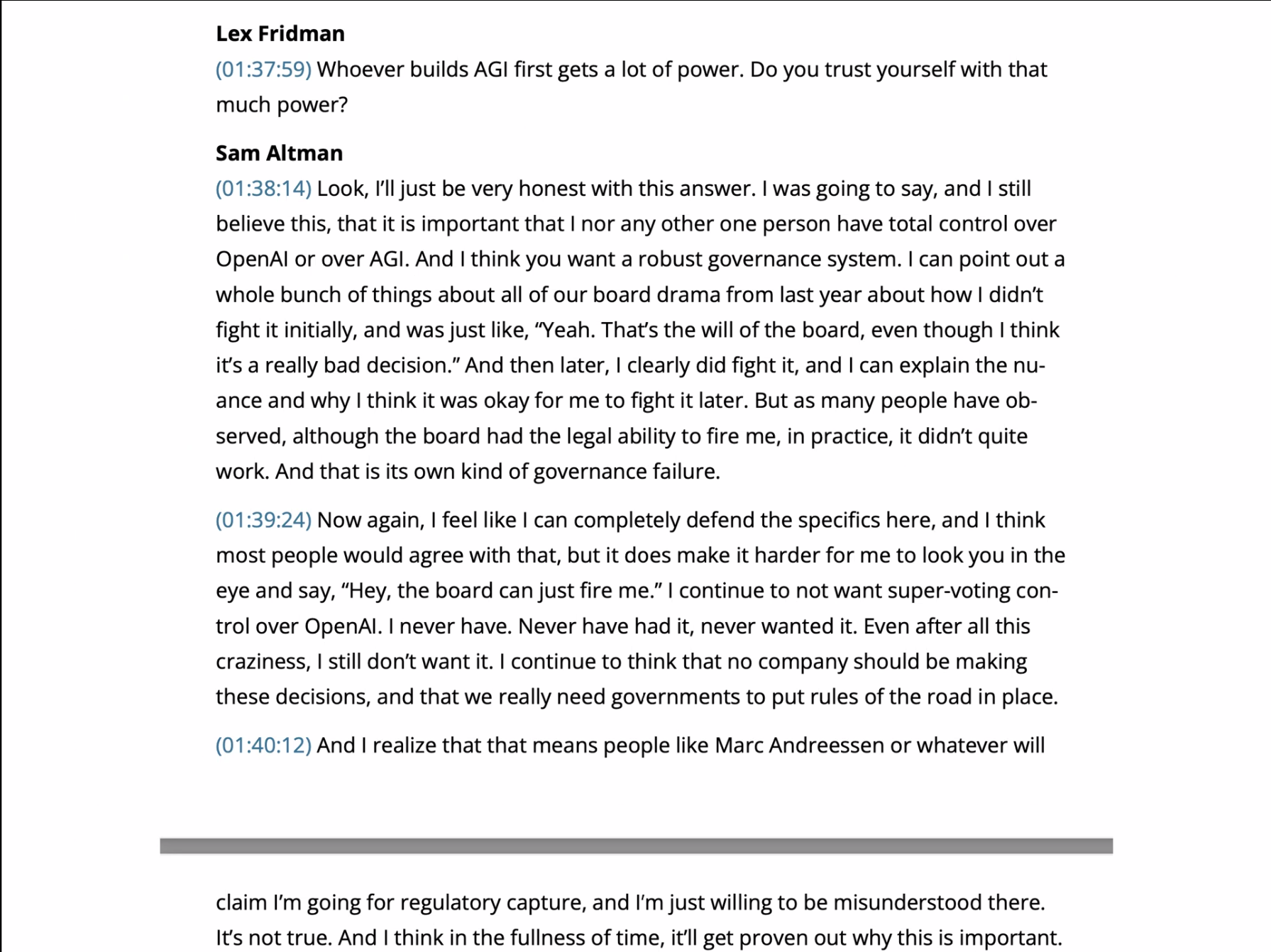
- And where he says that his perspective on it is that it's necessary to have government regulation of AI so in this way I guess we could say that Sam Altman is not exactly a kind of libertarian, of the kind that we know common in its Silicon Valley etc. 而且他说他的观点是,有必要对人工智能进行政府监管,这样我想我们可以说,山姆·奥特曼并不完全是我们所熟知的那种典型的自由意志主义者,比如硅谷等地常见的那种。
- Even if we don't want to say he's completely different, and even if maybe his perspective is unclear about exactly what kind of regulation that would mean, what he really is in favor of, what he really is against, what he really thinks is the a role of innovation... 即使我们不想说他完全不同,即使也许他的观点对具体什么样的监管意味着什么并不明确,他真正支持什么,他真正反对什么,他真正认为创新的角色是什么……
- It's easy to say a lot of things in an interview but nevertheless. 在采访中很容易说很多话,但尽管如此。
- His perspective here is that the power of this kind of technology is going to be extremely great, and that it's necessary to have some kind of localized authority, like a government, in order to control the direction of this development, and the use to which it's put. 他在这里的观点是,这种技术的力量将极其强大,因此有必要拥有某种地方性权威,比如政府,以便控制这种发展的方向及其用途。
- What do we want to say about that? 我们想说什么呢?
- I think the main thing that we want to say about that, is that it doesn't take account, nowhere does it take account, of the effects of this and many other technologies on the capacity of governments to govern. On the capacity of politicians, or members of governments, members of institutions of all kinds, to fulfill their function as an authority or as a regulator, and for those institutions to function well. 我认为我们想说的主要事情是,它没有考虑到,在任何地方都没有考虑到这项技术以及其他许多技术对政府治理能力的影响。对政治家或政府成员、各种机构的成员履行其作为权威或监管者职能的能力,以及这些机构有效运作的能力。
- And so that there's a contradiction in what Sam Altman is saying, unless we believe that he is capable of thinking through the consequences, on what we would call noesis, thinking, as a result of these technologies. 因此,Sam Altman 所说的存在矛盾,除非我们相信他能够思考这些技术的后果,即我们所说的 noesis,思考,因为这些技术的结果。
- And this is obviously where Bernard Stiegler is crucial for us, and why I said that the real question of AI is denoetisation, which is what he talks about in The Immense Regression. 而这显然是 Bernard Stiegler 对我们至关重要的原因,也是我说人工智能的真正问题是 denoetisation 的原因,这是他在《巨大的倒退》中讨论的内容。
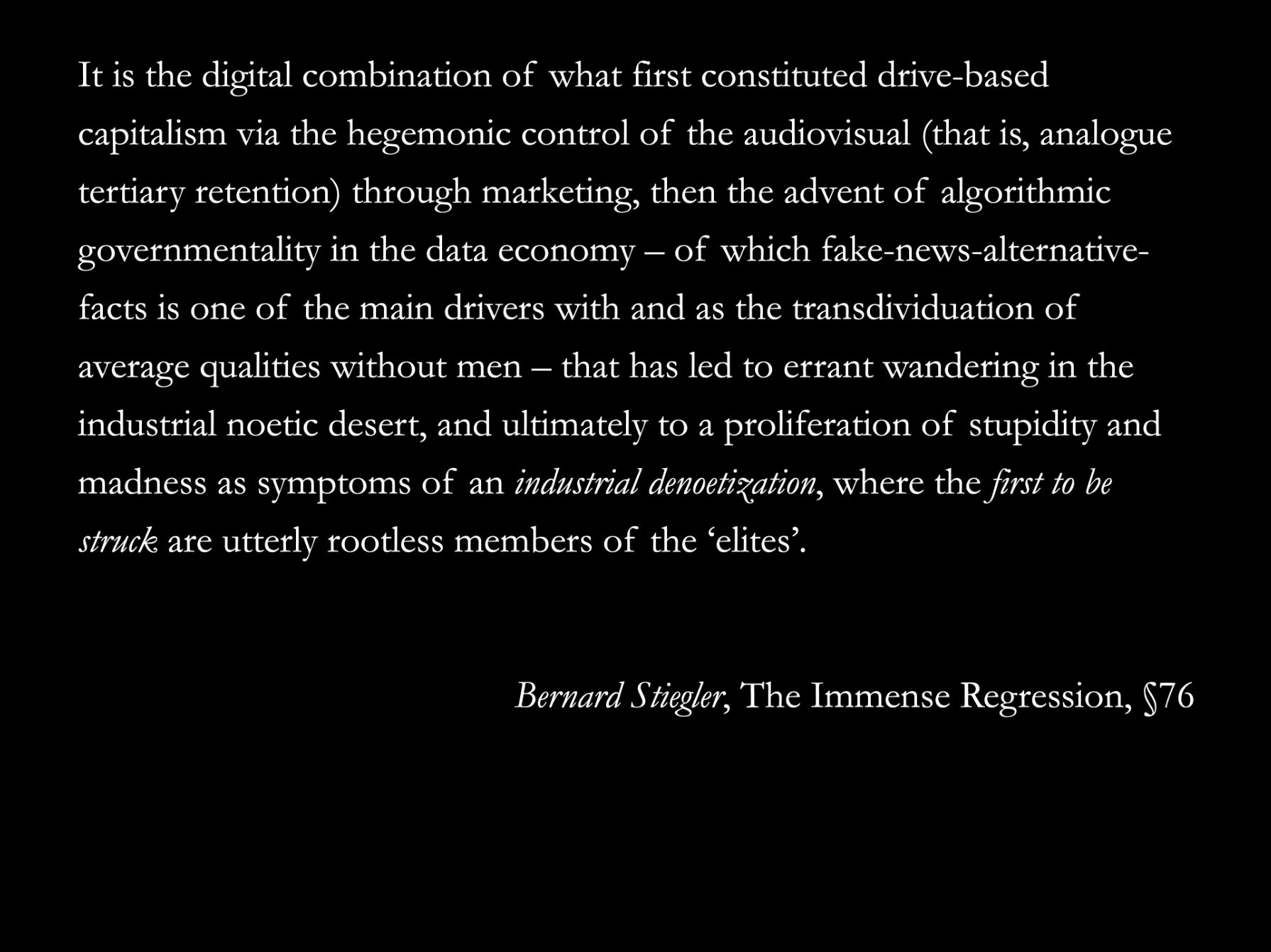
- So now let's look at some quotations in order to say... 所以现在让我们看看一些引语,以便说...
- (so this is the second part of the talk, I don't know how I'm doing for time but...)
- ...What (if we go right to the end of this quotation) we can see that Stiegler is raising this issue in terms of the idea that the first to be struck are utterly rootless members of the elites.
- In other words these kind of, I think he means, first in line these kinds of Silicon Valley billionaires and innovators and disruptors, and so on, are themselves the victims of what in most of his books he calls proletarianization, which I won't explain for you, because I'm sure you all know, but to put it as quickly as possible, is the notion that the different kinds of memory technology can aid in memory and knowledge and thinking, but also can destroy it.
- Where this quote here, "the first to be struck are utterly rootless members of the elites" is obviously a kind of variation on the quotation from the Communist Manifesto that Stiegler often liked to refer to that proletarianisation will affect all layers of the population, eventually affect all layers of the population, including governments.
- Now, he also refers in this quotation to "average qualities without men".
- "Qualities without men" obviously is a reference here to Robert Musil's book, Man Without Qualities, which is discussed a lot in this in The Immense Regression, and to think about that let's think for a moment about: why does Bernard Stiegler talk about entropy?
- Just give ourselves one minute to think about that.
- Entropy, although it was not known at the time of the formulation of the concept by the time of Boltzmann, is understood to mean a probabilistic tendency of the universe, probabilistic tendency in other words for things to level out towards their averages over time in a way that means that the past tends to be erased.
- To say that the past tends to be erased, is to say that the improbable tends to be eliminated by the probable.
- And the improbable that we're talking about here is not an improbability, of a very small probability, it doesn't mean a very small probability.
- It means something singular.
- Something that could not have been deduced, from the set of probable becomings.
- And before the event, such as life.
- And that where this improbable happens, it happens as a history that unfolds. As a dynamic process in other words.
- That that never undoes, and never can defeat, entropy and therefore can only ever be a temporally and spatially local process.
- Why does Stiegler want to add the terms anthropy and neganthropy to entropy and negentropy?
- He wants to add these terms because there is a new kind of probabilistic tendency that arises when life becomes exosomatic.
- That new probabilistic tendency is what becomes possible with the calculative processes that go through tools and machines, and make possible new kinds of leveling, new kinds of averages, new kinds of forgetting of the past, erasing of the past, by this, by the averaging of life.
- And this is what Robert Musil is talking about in the man without qualities when he discusses Kakania [Ed.: Austrian writer Robert Musil coined the term Kakania to describe the irony and absurdity of the highly bureaucratic Habsburg Empire]
- But, as Stiegler analyzes in that book, Musil's limitation is to want to think how probabilities can be put to use, but without him having the ability to think the improbable itself.
- In other words the singularity of localized life for us, cultural singularity, cultural locality, and so on.
- And that nevertheless we can look to Musil in order to see this diagnosis of the leveling by averages, and understand that this is what's unfolding for us today, but in a much more powerful way that Musil could never have imagined, where what is really singular is noesis itself.
- That is our capacity for thinking and caring, and so on
- And that when this is undone, Stiegler says, we have a proliferation of stupidity and madness and the question of denoetization, is a question of the industrial use of retentions (of tertiary retentions, that is the traces that we leave), the industrial use of retentions for the control of protentions (that is dreams, desires, anticipations, and so on.
- Alright. 好的。
- And the way in which AI is a step, and ChatGPT for example is a step, in that process of producing an industrial noetic desert based on analysis of texts that themselves increasingly will be automated, and which have all kinds of other biases and so on,
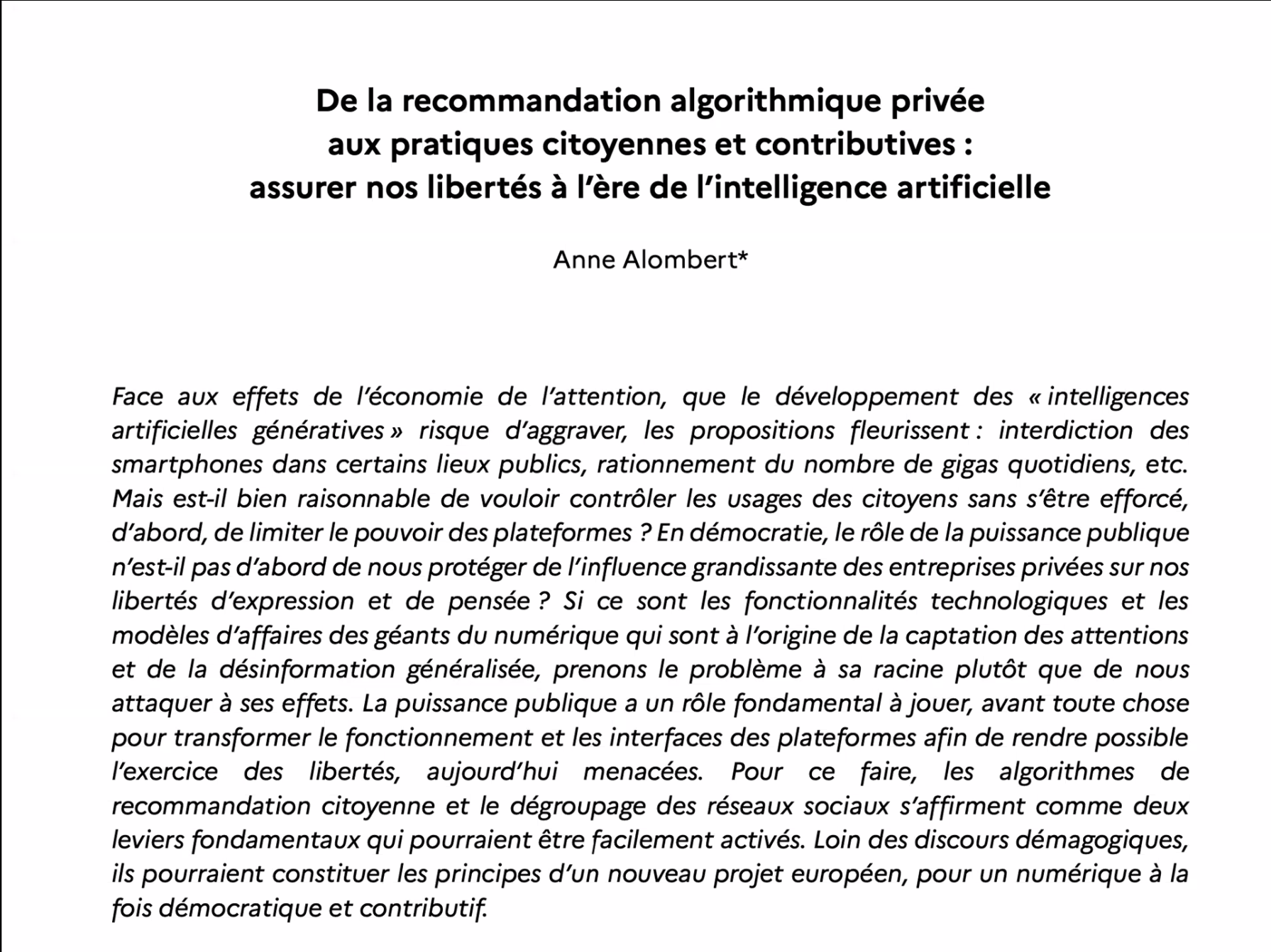
- One of one of the better analysts of this in my view is Anne Alombert, is somebody you probably all know, in this kind of paper, and also in her book that she published last year and which will be published in an excellent English translation next year, to be titled Digital Schizophrenia. 我认为,在我看来,其中一位对这个问题分析得比较好的人是 Anne Alombert,你们可能都认识她,在这类文章中,以及在她去年出版的书里,这本书明年将被翻译成优秀的英文出版,书名将是《数字分裂》。
- Okay, back to Bernard. 好的,回到伯纳德。
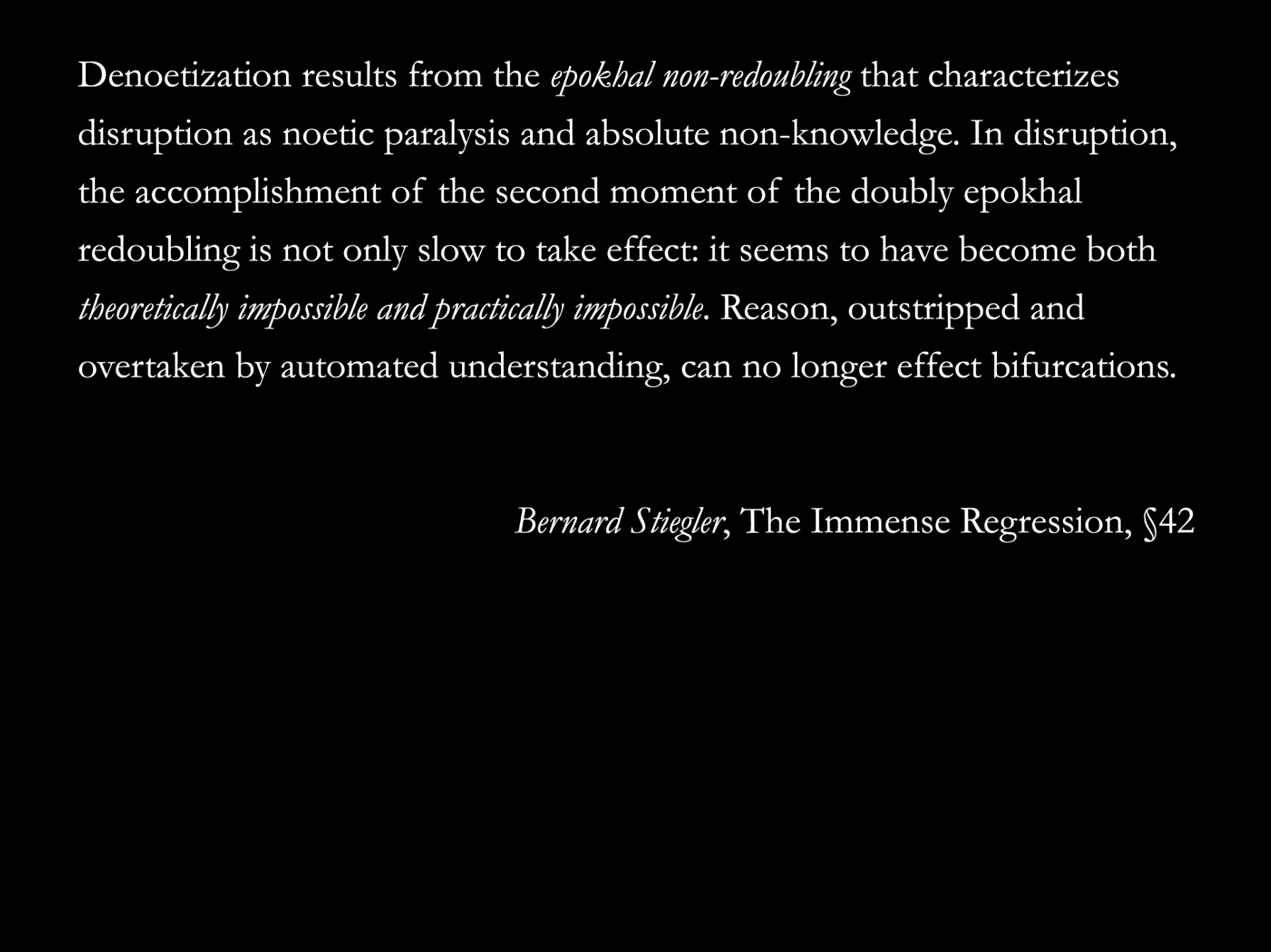
- So to put this another way, as you know, Bernard loves the phrase doubly epokhal redoubling. 所以换个说法,正如你所知,伯纳德喜欢这个短语双重的 epokhal 加倍。
- Where the idea there is that life unfolds as, exosomatic life unfolds as, a constant advance and delay of a two-step process. 那里的想法是,生活展开为,外在生活展开为,一个不断前进和延迟的两步过程。
- The first is a disruption that occurs to the technical system, that throws existing ways of taking care of life in that system, and taking care of that system, into a disruption 第一种是技术系统发生的扰动,这种扰动会将现有的生命照料方式和对该系统本身的照料方式抛入扰动之中
- Which requires a renewal of those other systems ("other systems" being a phrase he takes from Bertrand Gille) and that this renewal of those other systems, cultural systems, social systems, in turn produces changes gradually in the technical system eventually leading to further disruptions, or another tool is invented that changes the basis of the technical system, and so on. 这需要对那些其他系统(“其他系统”一词他取自伯特兰·吉尔)进行更新,而这些其他系统的更新,即文化系统、社会系统的更新,会逐渐导致技术系统的进一步变化,最终引发进一步的扰动,或者发明了另一种工具来改变技术系统的基础,如此等等。
- But for this to be possible requires us to have the knowledge and the care, to be able to take care in new improbable ways
- It's a question of new improbabilities.
- And so what he's diagnosing, as the threat of denoetization, where these kind -- all of our thinking for Bernard as you know, all of our thinking is possible only because it is in a circuit, with the tools that we have, and especially with the memory tools that we have.
- But at the same time, if the speed and the power of those tools is used in a way that systematically controls protentions in advance of our ability to think about them or take care of them, then this seems to be a double threat, not only a disruption of the technical system but a disruption of our ability to respond to those changes.
- And so this second moment becomes impossible, which he describes as it "no longer being possible to effect bifurcations" where bifurcations are also, he says in this same book, another name for what in the past used to be called miracles. 因此,这个第二个时刻变得不可能,他将其描述为“不再可能产生分歧”,而分歧,他说在这本书的同一章节,也是过去被称为奇迹的另一种说法。
- Alright. 好的。
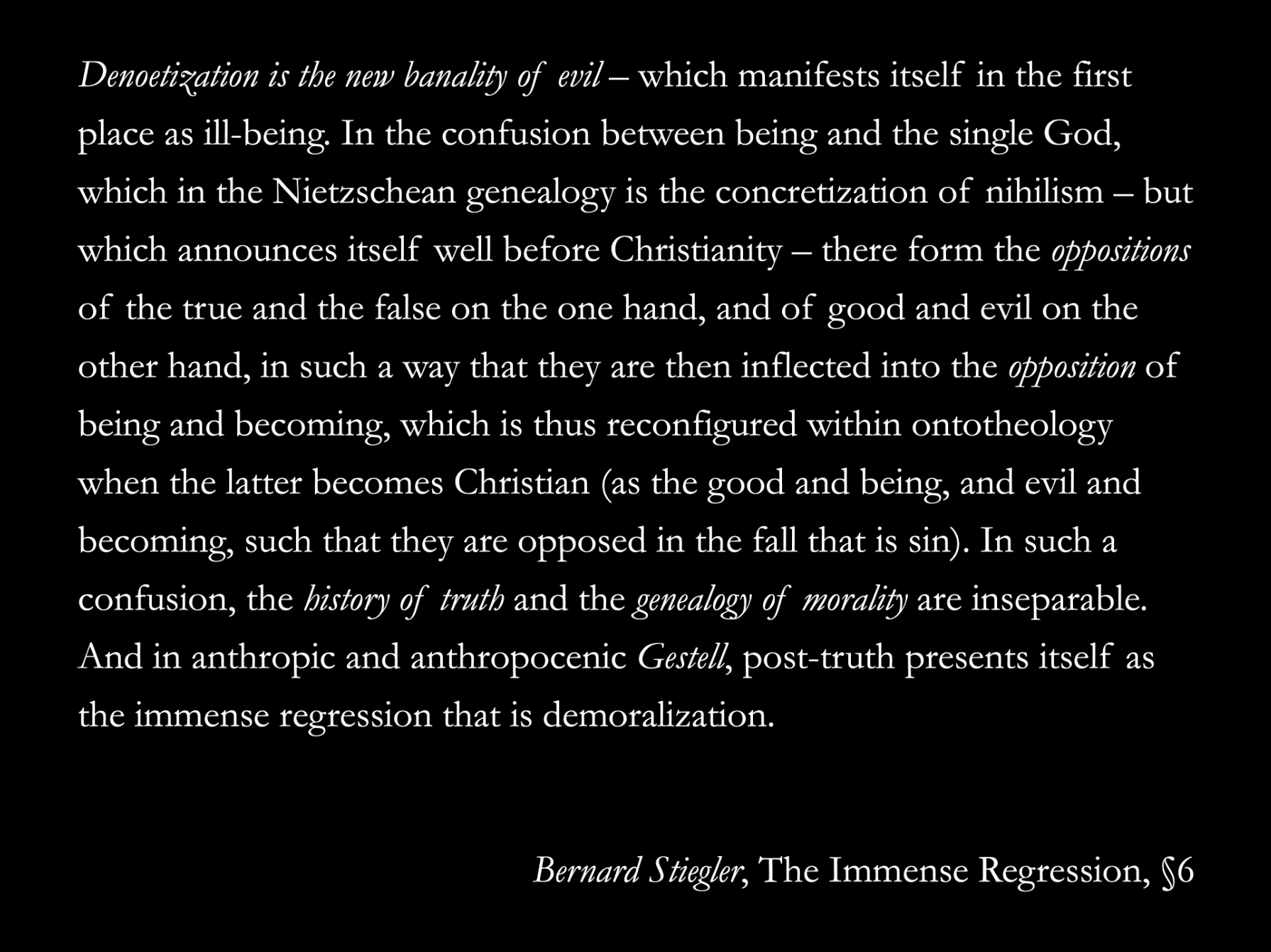
- Of course it is not news to anybody here, that what we're talking about, when it's no longer possible for good care to be taken of the pharmakon by the pharmakon, then this is the moment at which it becomes inevitable that there will be a search for the pharmakos (that is for the scapegoat) and this is why Stiegler called the scapegoat "the third dimension of pharmacology". 当然,这里没有人会对我们所谈论的内容感到惊讶:当好药无法再被药所治疗时,就到了寻找替罪羊(即替罪羊)的时候,这就是为什么斯蒂格勒称替罪羊为“药理学的第三维度”。
- When we're no longer in a position -- when we're not able -- when we don't succeed in taking care of the pharmakon, in other words we have problems brought about by our use of technology that we don't manage to find new improbable solutions to, or good solutions to, neganthropic solutions, then we begin to look for a scapegoat. 当我们不再能够——当我们无法——当我们无法照顾好 pharmakon 时,换句话说,我们因为使用技术而遇到问题,却无法找到新的、不太可能的解决方案,或者好的解决方案,即 neganthropic 解决方案,那么我们就开始寻找替罪羊。
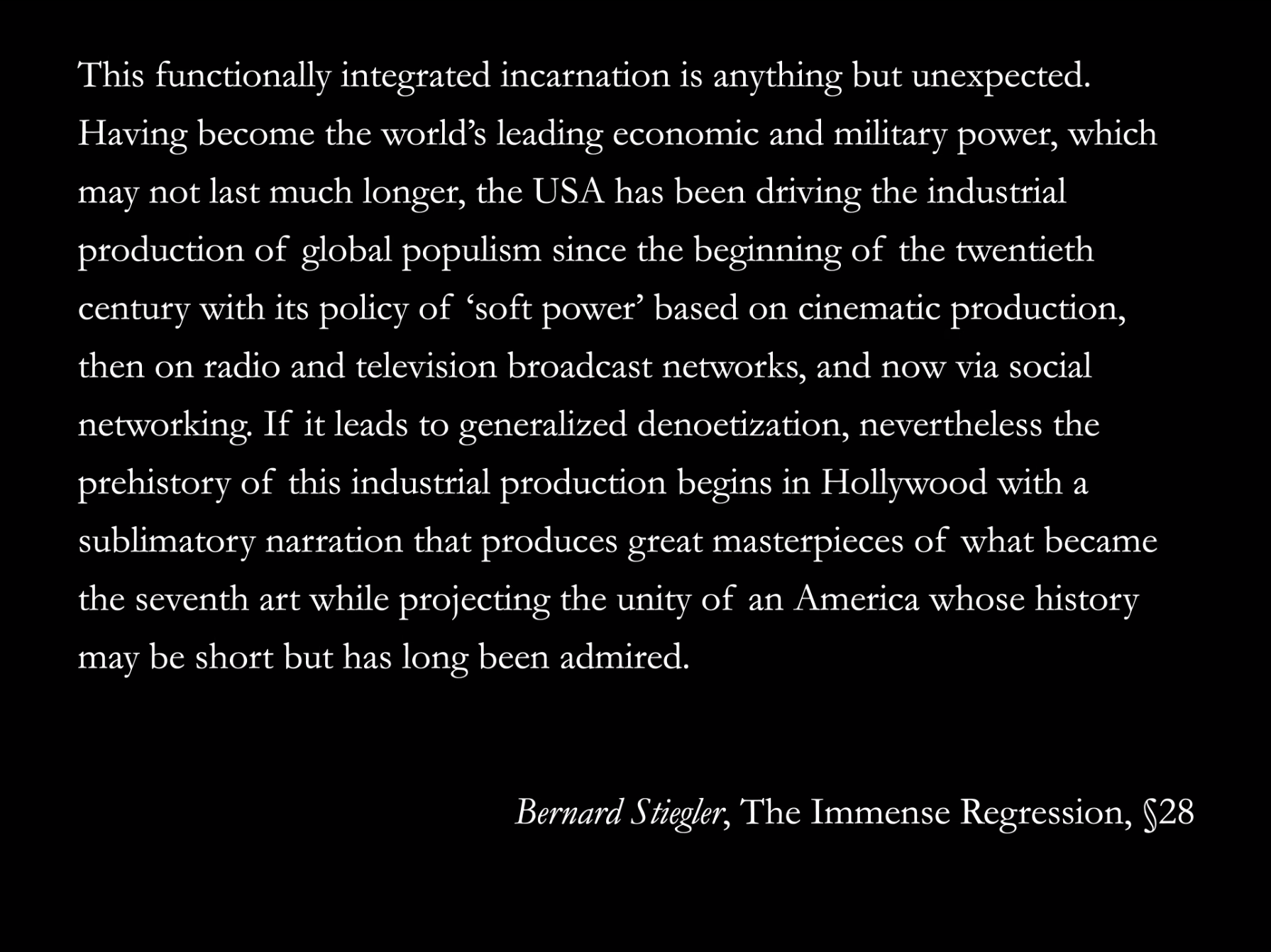
- And this becomes, in the 20th century, the rise of populism. 而在 20 世纪,这变成了民粹主义的兴起。
- And this continues as you know in the 21st century, and many people understand that there is a connection between this kind of very powerful use of network effects and memetic effects, and their tendency to produce forms of political expression that are dependent on searching for scapegoats.
- And which are usually characterized as far-right populism.
- Obviously this is the case.
- This is the type of stupidity and madness that we face today.
- At the same time, I think it's necessary to remember that in his diagnosis of post-truth, and the relation it has to fake news, alternative facts, and the like, what Stiegler wanted to say as well is that responses to this kind of phenomenon that are intended as responses in the name of not scapegoating, very often have a scapegoating character about them.
- And one of the reasons for that is because they themselves, these kinds of responses themselves, forget that facts are never simply a question of being laid out without requiring interpretation so responses of the kind like fact-checking sites, are based on a kind of wish to be to be anti-scapegoating in some way, but in the end are themselves a kind of denial and madness that denies the necessity of interpretation of life.
- And so they themselves are a symptom.
- (I'm moving through a little bit faster than what I wanted but I think it's necessary)
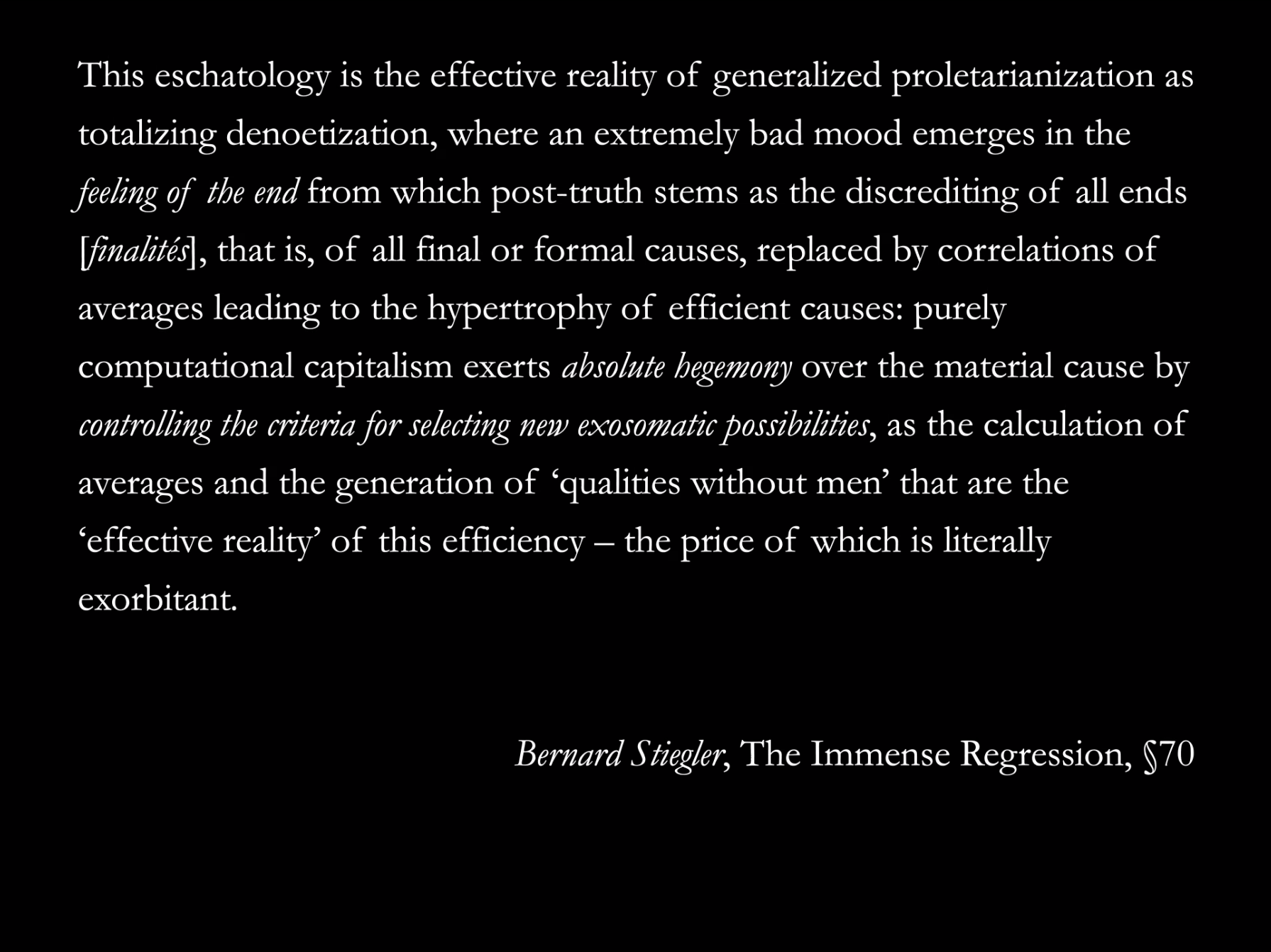
- Now here I just will say that this kind of use of AI, Stiegler's diagnosis is also in terms of the four causes (Aristotle's four causes) in which what's going on is that there is a hegemony of the efficient cause.
- The efficient cause dominates over all other causes, and especially over final causes.