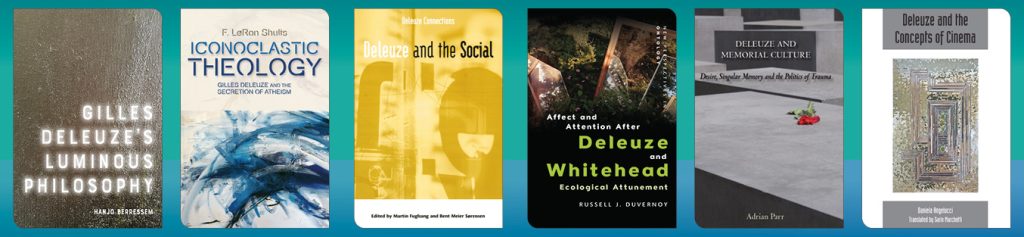
2025 marks the centenary of the birth of Gilles Deleuze. Throughout the year, we’ll be taking the opportunity to explore the impact of this towering figure in twentieth-century philosophy. 2025 年是吉尔·德勒兹诞辰百年。在这一年里,我们将借此机会探讨这位二十世纪哲学巨擘的影响。
As part of this celebration, we’re publishing a series of blogs from leading Deleuze scholars. Read on to discover how Deleuze’s philosophy transformed Brian Massumi’s way of thinking and being. 作为庆祝的一部分,我们将发布一系列来自杰出德勒兹学者的博客。继续阅读,了解德勒兹的哲学如何改变了布莱恩·马苏米的思维和存在方式。
‘Breadth of thought reacting with intensity of sensitive experience.’ This is Whitehead’s statement of what justifies a metaphysical system. It is also, he says, the ‘ultimate claim of existence.’ Thought is for life; life is ‘aim at intensity.’ “思想的广度与敏感体验的强度相互反应。”这是怀特海对什么证明形而上学体系合理性的陈述。他说,这也是“存在的终极主张。”思想是为了生命;生命是“追求强度。”
Few philosophies deliver on this immediate entanglement of abstract thought and ‘zest’ for life. Deleuze’s (and Deleuze and Guattari’s, and Guattari’s) do. That is why I took to it – or it took me. 很少有哲学能够实现抽象思维与对生命“热情”的这种直接交织。德勒兹的(以及德勒兹和加塔利的,以及加塔利的)哲学做到了。这就是我选择它——或者说,它选择了我。
Suffering through adolescence in an arch-conservative region of the United States, breadth of thought paired with intensity of sensitive experience was not generally on offer. The atmosphere was stiflingly anti-intellectual. Support for militarism and the Vietnam War was reflexive. Gender norms allowed of no plasticity. The budding environmental movement, into which I dived headlong, was considered ‘un-American.’ It was all about American, male, human supremacy. As for intensity, it was mistaken for stimulation. I recently read a psychology study that, it struck me, retrospectively summed it up. People were asked to sit quietly alone in a room with their thoughts for between six and fifteen minutes. They were given the option to cut off the thinking by self-administering mild electric shocks. Two thirds of men chose the stimulation. Urge to unthinking. If this were a city, it would be Phoenix, Arizona (circa 1970 in chronological time, corresponding to 1955 in cultural time). Had I not banded together with a tiny pack of fellow misfits, all of whom today would be considered neurodiverse, it would have been unlivable. 在美国一个极端保守的地区度过青春期,思维广度与敏感体验的强度通常是无法得到的。气氛压抑,充满反智主义。对军国主义和越南战争的拥护是本能的。性别规范不允许任何灵活性。我全身心投入的萌芽环境运动,被认为“非美国化”。一切都关乎美国的、男性的、人类的优越性。至于强度,它被误认为是刺激。我最近读了一项心理学研究,让我觉得它回顾性地总结了这一切。人们被要求独自在房间里安静地思考六到十五分钟。他们可以选择通过自我施加轻微电击来切断思考。三分之二的男性选择了刺激。无意识的冲动。如果这是一个城市,它将是亚利桑那州的菲尼克斯(时间上约为 1970 年,对应文化上的 1955 年)。如果我没有和一小群同样格格不入的同伴们联合起来——他们今天都会被认为是神经多样性人群——这将无法生存。
In reaction, I became a compulsive thinker. I intuitively yearned for the entanglement of abstract thought and zest for life, so missing in the drab normality my general surroundings offered me. I didn’t experience it as optional. It was a necessity of survival. I understood at some level that I had to think hard to get out alive. The endeavour would eventually detour me from the environmental activism to which I had intended to dedicate my life, into philosophy. That philosophical pursuit of life became a life pursuit. 作为回应,我变成了一个强迫性思考者。我直觉地渴望抽象思维与生活热情的交织,而这在我周围单调的日常生活中是多么缺失。我不认为这是可选择的。这是生存的必要条件。我在某种程度上明白,必须努力思考才能活下来。这种努力最终将我引离了原本打算为之奉献一生的环境活动,转向了哲学。这种对生活的哲学追求变成了我生活的追求。
Merleau-Ponty’s existential phenomenology fufilled the need for a time. But then I was administered a different kind of shock: Anti-Oedipus. I was inspired to read the book by the eponymous issue of Semiotext(e), published in 1977. Reading Anti-Oedipus delivered a true dose of intensity. The thinking struck me as infinitely precise – if only I could grasp the key to its precision! – and as stormy as a massing thunder cloud. It was expansive, leading, it seemed, in all directions, across a plethora of disciplines. Its language crossed levels as well, from the crassest interjection to the most scholastic formulation. The topics covered all levels of the world’s order, from many sexes of the molecular to the Absolute State. Its intensity was the way it multiplied potential trajectories across the levels and orders, in varying directions, each adding an emergent shape to the billow of thought. This was not mere thought, wan reflection. It was a staging of potential, in the living, for the living, for a more to life. The book followed me through my days. It infected my perceptions. If perception, as Bergson said, is virtual action, then thinking one’s way into new powers of perception expands the field of potential actions. Or as Spinoza says, an increase in the power of thought coincides with an increase in the power to act. Foucault’s comment in the preface to the English translation that Anti-Oedipus was an introduction to non-fascist life is not a throw-away line. It’s a life-line. The concepts’ staging of potential is enactive: its intensity demands that the concepts be lived, in as exploratory a manner as they are deployed in the writing. This cannot be done under the mantle of reaction. It can only be done in the book’s own mode of urgent, exigent, affirmation. 梅洛-庞蒂的存在主义现象学满足了那个时代的需要。但随后我经历了一种不同的冲击:反俄狄浦斯。是《符号文本(e)》1977 年出版的同名特刊激发了我阅读这本书的灵感。阅读《反俄狄浦斯》带来真正的强烈体验。这种思考让我感到无限精确——如果我能够抓住其精确的关键!——就像暴风雨前的乌云一样狂暴。它非常开阔,似乎引领着所有方向,跨越了众多学科。它的语言也跨越了不同层次,从最粗俗的感叹词到最学术的表述。它涵盖的世界秩序的所有层面,从分子的多种性别到绝对国家。它的强度在于它在不同层次和秩序中创造了多种潜在轨迹,以不同的方向发展,每个方向都在思想的波澜中增添了新的形态。这不是简单的思考,也不是苍白无力的反思。它是对潜在性的展演,为生命而展演,为更丰富的生命而展演。这本书伴随着我度过每一天,它感染了我的感知。 如果感知,正如伯格森所说,是虚拟行动,那么通过思考获得新的感知能力就能扩展潜在行动的范围。或者,如斯宾诺莎所说,思维能力的增强与行动能力的增强相辅相成。福柯在《反俄狄浦斯》英文译本前言中评论说这本书是非法西斯生活导论,这并非随口一提。这是救命稻草。概念对潜能的呈现是具身化的:其强度要求概念必须被生活化,就像它们在写作中运用的探索性方式一样。这无法在保守主义的庇护下完成。它只能以书中那种迫切、要求、肯定的独特方式完成。
Merleau-Ponty, once much loved, was no longer so vital. Against his humanism, Anti-Oedipus beckoned to regions beyond. It opened the enclosure of the all-too-individual sense of the human to transindividual breadth of movement, on an infinitely textured nature-culture continuum. The world, it signaled, extended far beyond the six-foot high suburban fence hemming the modern capitalist nuclear-family home. What vistas! The allure was immediate, but the precision would come only slowly, over years of reading other works by Deleuze and by Guattari. Most of all A Thousand Plateaus, whose painstaking patience and constructive sobriety did not so much, in my reading, repudiate Anti-Oedipus as otherwise intensify the movement of thought running through it. Lines of their thinking also led out, into adjacently entwined philosophies, such as those of Bergson, James, Simondon, Ruyer and especially Whitehead. 梅洛-庞蒂曾经备受喜爱,但不再那么重要。在他的以人为本主义面前,《反俄狄浦斯》召唤着超越人类主义的领域。它将人类过于个体化的感知围栏打开,扩展到跨个体广阔的运动,在无限纹理的自然-文化连续体上。它暗示着世界远远超出了围住现代资本主义核心家庭住宅的六英尺高的郊区栅栏。多么壮丽的景象啊!诱惑是即时的,但精确性只会慢慢到来,需要数年阅读德鲁兹和加塔利的其他作品。最重要的是《千高原》,它那细致入微的耐心和建设性的庄重,在我阅读中并没有那么强烈地否定《反俄狄浦斯》,而是以其他方式强化了贯穿其中的思想运动。他们的思想线条也延伸出去,进入相邻交织的哲学领域,如伯格森、詹姆斯、西蒙东、吕耶以及尤其是怀特海。
I recently received an email from a Chinese philosophy student asking if I embraced the category ‘post-Deleuzian.’ It was implied my work was assigned that category in China, I assume because of the increasing presence of Whitehead in it and on the more general level, the presupposition of a period-based approach to the history of thought taking it for granted that, a hundred years on from Deleuze’s birth, we must necessarily be on to somewhere else. The question took me aback. My immediate reaction was: once affected by Deleuzian thought, there is no post-. There is ‘after’ Deleuze, but in the sense of an aftermath. What it is to think, reacting with sensitivities of experience, will have forever been changed. The momentum of the work encourages coursings away from it. But at the same time its power to affect abides, setting the lure to eddy back. Case in point from my own trajectory: when it came time to grapple with what was singular about contemporary fascism the only way forward seemed to be to circle back, to Anti-Oedipus – still, to my mind, the most potent prolegomenon to non-fascist thinking for anti-fascist life ever written. But the ‘aftering’ also holds on the larger cultural level as well. ‘Philosophy,’ Whitehead writes, ‘never reverts to its old position after the shock of a great philosopher.’ It courses on and eddies in the wake. 我最近收到一位中国哲学学生的邮件,问我是否认同“后德勒兹”这一范畴。邮件暗示我的作品在中国被归为此类,我猜测是因为其中白 head 的日益增多,以及更普遍层面上,对思想史分期方法的预设——即在一百年后的今天,我们必然已经进入了新的阶段。这个问题让我有些措手不及。我的第一反应是:一旦受到德勒兹思想的影响,就不会有“后”。存在“德勒兹之后”,但那是指一种余波。思考本身,在经验敏感性的反应下,将永远改变。作品的动力鼓励人们远离它。但与此同时,它的影响力依然存在,吸引人们回旋。以我自己的轨迹为例:当需要探讨当代法西斯主义的独特性时,唯一的前进方式似乎是回到《反俄狄浦斯》——在我看来,它仍然是针对反法西斯生活、非法西斯思考的最有力序言。 但“之后”也体现在更广泛的文化层面。怀特海写道,“哲学在一位伟大哲学家的冲击后,永远不会回到它的旧位置。”它继续前行,在余波中回旋。
I answered the email from the Chinese student with a brief attempt to express how a philosophy continues, ‘after’ all, in a no ‘post-‘ way. I leant on Whitehead again (it has come to the point that I cannot think without thinking them together). His description of how a metaphysical system works provides an image of thought as a generative system whose openness in no way belies its rigour. Every concept, he says, links to every other concept. So far, so commonplace. But Whitehead immediately veers: the connection, he says, does not take place on the level of the explicit meaning of the concept’s verbal formulation. It lies in what what each concept does not say. In other words, there is an order of implication that subtends the manifest meaning. It is in that implicate order that the system’s true consistency lies. What the other concepts in the system represent for a given concept is the potential for its meaning to be modulated by a shift somewhere else in the implicate web of connections. Each iteration of a concept modulates the order of implication across the board, jogging the entire systemic order with a ripple of difference. The mobilization of a concept is like a fly striking a spider web. Every fiber across the entire web vibrates in tune with the perturbation. Except with the conceptual web, the shape of it changes and its expanse dilates and contracts. 我回复了那位中国学生的邮件,简要地尝试表达哲学是如何继续的——毕竟,它并没有以“后”的方式终结。我又一次借助了怀特海的理论(现在到了我无法不将他们联系在一起思考的地步)。他描述的形而上学体系运作方式,为思维呈现为一个生成系统提供了形象,其开放性丝毫不违背其严谨性。他说,每个概念都与所有其他概念相连。到目前为止,这很常见。但怀特海立刻转向:他说,这种连接并不发生在概念语言表述的显性意义上。它存在于每个概念所没有表达的内容中。换句话说,存在一个隐含的意涵秩序,支撑着显性意义。正是在这个隐含秩序中,体系的真正一致性得以体现。体系中的其他概念对于一个特定概念所代表的是,其意义被隐含连接网络中某处的变化所调节的潜力。一个概念的每一次迭代都会全面调节隐含意涵秩序,以差异的涟漪触动整个系统秩序。 一个概念的动员就像苍蝇撞到蜘蛛网上。整个网上的每一根纤维都会随着扰动而同步振动。但概念之网不同,它的形状会改变,范围会扩张和收缩。
This defines a metaphysical in terms of its potential to generate further ordering effects. Systems of implication have a consistency due to the relational linkage across the web, but they do not have assignable boundaries. A system of thought is not an edifice of fully articulated ideas. A strong thought positively incompletes itself. It is productively ungrounded by the strength of its own consistency. Which is to say, its own intensity. Intensity is not mere stimulation. Neither is it a greater magnitude of thought or experience (as if they were extensive quantities subject to measure). Intensity is the tenor of potential implicate in a web of connection, as enveloped in a particular strike that the consistency of that field of relation enables. 这一定义了一个形而上学的概念,根据其产生进一步排序效应的潜力。关联系统由于网络中的关系链接而具有一致性,但它们没有可指定的边界。一个思想系统并非一个完全阐述清楚的思想建筑。一个强大的思想积极地不完善自身。它由自身一致性的力量积极地未扎根,也就是说,它自身的强度。强度并非仅仅是刺激。它也不是思想或经验的更大量级(好像它们是可测量的广阔量)。强度是连接网络中潜在隐含的基调,被该关系领域的一致性所赋予的特定冲击所包裹。
Approaching a system of thought this way grasps it from the angle of its generative plasticity. The difference between Anti-Oedipus and A Thousand Plateaus, or between Deleuze and Deleuze-Guattari and Guattari, is then not to be sought on the doctrinal level of the concepts’ explicit meaning. The question is not how can one be compared to the other, or if they are in conformity with each other, as if they were structures of meaning of fixed size and expanse. This question is: in what way is one the transform of the other? By what systemic modulations do we pass from one to the other? How does one extend, prune, or positively deform the relational consistency of the other, at the infra-level of its potential for generating new expressions? In what way does this plumbing of a thought’s potential create a nonlinear backwash that alters what the system of departure will have been? The answer to these questions takes the form of an order of passage. 以这种方式面对一个思想体系,是从其生成性可塑性角度把握它。反俄狄浦斯与千高原之间的差异,或德勒兹与德勒兹-加塔利和加塔利之间的差异,不应在概念显性意义的原则层面上寻找。问题不在于如何将两者进行比较,或它们是否相互一致,仿佛它们是固定大小和范围的意义结构。这个问题是:两者是如何相互转化的?通过什么系统性调节我们从一个过渡到另一个?一个如何扩展、修剪或积极变形另一个在生成新表达潜能的基础层面的关系一致性?这种挖掘思想潜能的方式如何产生非线性回溯,从而改变出发体系将是什么?对这些问题的回答采取了一种过渡秩序的形式。
The question for a thinker coming after is: How can one deploy operators of passage (mots de passe, as the Deleuze-Guattari of A Thousand Plateaus might say) to faithfully depart from a thinking into a thought of one’s own confection, like a conceptual gear-shift mechanism? In The Personality of Power, I used a minor concept from Guattari and Deleuze-Guattari for this purpose. The ‘point-sign’ (a minor concept if there ever was one, so elusive it is in their work, so full of implicit complexity) became a gear-shift into my own systematization of the thought of fascism, which a periodizer would be likely to qualify as ‘post-Deleuzian’ due to its attempt to construct an order of implication holding together simultaneous, mutually imbricated transforms of other thinkers (Whitehead once again, but also Peirce, James, Simondon, Susanne Langer and even the redoubtable Carl Schmitt). 对于一位后继的思考者来说,问题在于:如何运用过渡操作符(正如《千高原》中德勒兹-加塔利所说的“关键词”),忠实地从一个思考过渡到对自己构想的思想,就像一个概念变速机制?在《权力的个性》中,我使用了加塔利和德勒兹-加塔利的“点标”(如果曾经有过“小概念”的话,它在他们的作品中如此难以捉摸,如此充满隐含的复杂性)来实现这一目的。这个“点标”成为我思想中法西斯主义系统化的变速器,一个时期化者可能会因为其试图构建一个包含其他思考者同时、相互交织的转换的蕴含秩序,而将其归类为“后德勒兹主义”(例如怀特海,还有皮尔斯、詹姆斯、西蒙东、苏珊娜·朗格,甚至令人敬畏的卡尔·施密特)。
To restate the question raised by the trope of the ‘post-‘: when a thought comes after, can its relation to an antecedent thought be understood as a transform? The answer is always yes – if the proper order and level of implication is lit upon which enables an order of passage to be effectively constructed. This ‘if’ is more a matter of desire than it is a factual question. An order of passage can always be constructed. And it can always be blocked. It is a decision, to perform a continuation or to cut (going back to the etymological meaning of the word ‘decision’). When it comes to Deleuze, I desire/decide not to cut, while continuing not the same. However many passages I have made after and away from his work, I feel I can still say, in the same way Deleuze said reflecting back on his own work that what he did was, in spite of touching on virtually every modern discipline, ‘philosophy, nothing but philosophy’: Deleuze, nothing but Deleuze. The work’s intensity carries an unparalleled generative power that makes Foucault’s other well-known dictum – that this will be the Deleuzian century – also more than a throw-away line. 重申“后-”这一概念所提出的问题:当一个思想出现在另一个思想之后,它和先前的思想之间的关系能否被视为一种转化?答案是肯定的——只要找到恰当的顺序和隐含层次,就能有效地构建一种过渡秩序。这个“只要”更多地关乎愿望而非事实问题。过渡秩序总可以被构建,也总可以被阻断。这是一个决定,是选择延续还是切断(回归“决定”一词的词源意义)。谈到德勒兹,我渴望/决定不切断,但延续的并非同一事物。无论我之后远离他的作品做出了多少过渡,我仍能像德勒兹反思自身作品时所说的那样说,他所做的是,尽管几乎触及了所有现代学科,“哲学,不过是哲学”:德勒兹,不过是德勒兹。作品的强度蕴含着无与伦比的生成力量,这使得福柯的另一句著名论断——这将是一个德勒兹的世纪——也不仅仅是一句随口说说。
了解更多关于我们的德鲁兹百年庆典活动